
Five client projects at once: staying on top without chasing people
Why status gets lost between projects in small agencies – and which four views let you know on Monday morning, in ten minutes, where everything stands.
The short version
- It isn't the volume of work that overwhelms small agencies – it's switching between projects, and every switch costs run-up time.
- Four views cover the week: all projects side by side, my tasks across every client, the timeline, and whatever is stuck.
- The Monday meeting only works if nobody has to collect status beforehand – otherwise ten minutes turn into an hour of prep.
- „Just checking in“ isn't a communication problem. It's the symptom of a missing view.
Monday, 9am, four people. On the table: five clients. A relaunch going live in two weeks, two ongoing retainers, a shop with a bug from Friday evening, and a new client whose content has been missing for three weeks. „Where are we?“ is a simple question and it takes forty minutes.
Not because nobody is working. Because the state of things lives in five heads, three chat threads and a spreadsheet somebody last touched on Wednesday. Anyone who wants an overview has to collect it – and while they collect it, they aren't working.
Why status gets lost between projects
Inside a single project, most teams keep track effortlessly. The problem only appears across several clients, and it has three causes that compound.
The first is context switching. If you spend the morning on a relaunch and the afternoon fixing a shop bug, you need run-up time each way: what was this about, where did we leave it, what did we promise whom. That run-up is real work that nobody schedules.
The second is scattered channels. Client A emails, client B sends voice notes, client C got a Slack channel, and the shop bug came in by phone. Five clients easily become eight places where something might be waiting.
The third is the chasing itself. Because nobody can see the state, people ask – and every question interrupts someone who then needs their own run-up. That's how you get an agency where everyone is busy and nobody knows whether the relaunch date holds.
Four views that carry the week
The way out isn't another meeting. It's that the state is visible without preparation. Four angles on the same data are enough:
- All projects side by side: progress, an owner and the next milestone per client. The view for „where is it burning?“
- My tasks across all clients: one list per person, spanning projects. The view for „what am I doing today?“
- The timeline: which milestones fall in the same weeks. The view for „can we even take on the new client in September?“
- What's stuck: everything waiting on a delivery, an approval or a decision. The view for „why is nothing moving?“
The crucial part is that these are four angles on one set of data, not four maintained lists. The moment someone has to keep an overview current by hand, it's wrong by Wednesday – and from then on you're back to chasing people.
The one separation worth making first
One thing pays off before anything else: keeping client requests and internal tasks apart. What the client reports is a request – it belongs to them and gets answered. What you make of it is a task – it belongs in the project and gets an owner.
It sounds like bureaucracy, but it saves the most common follow-up question of all: „what happened to the thing I reported last week?“ With request and task linked, the answer is a glance instead of an investigation.
Where IssuePilot takes over
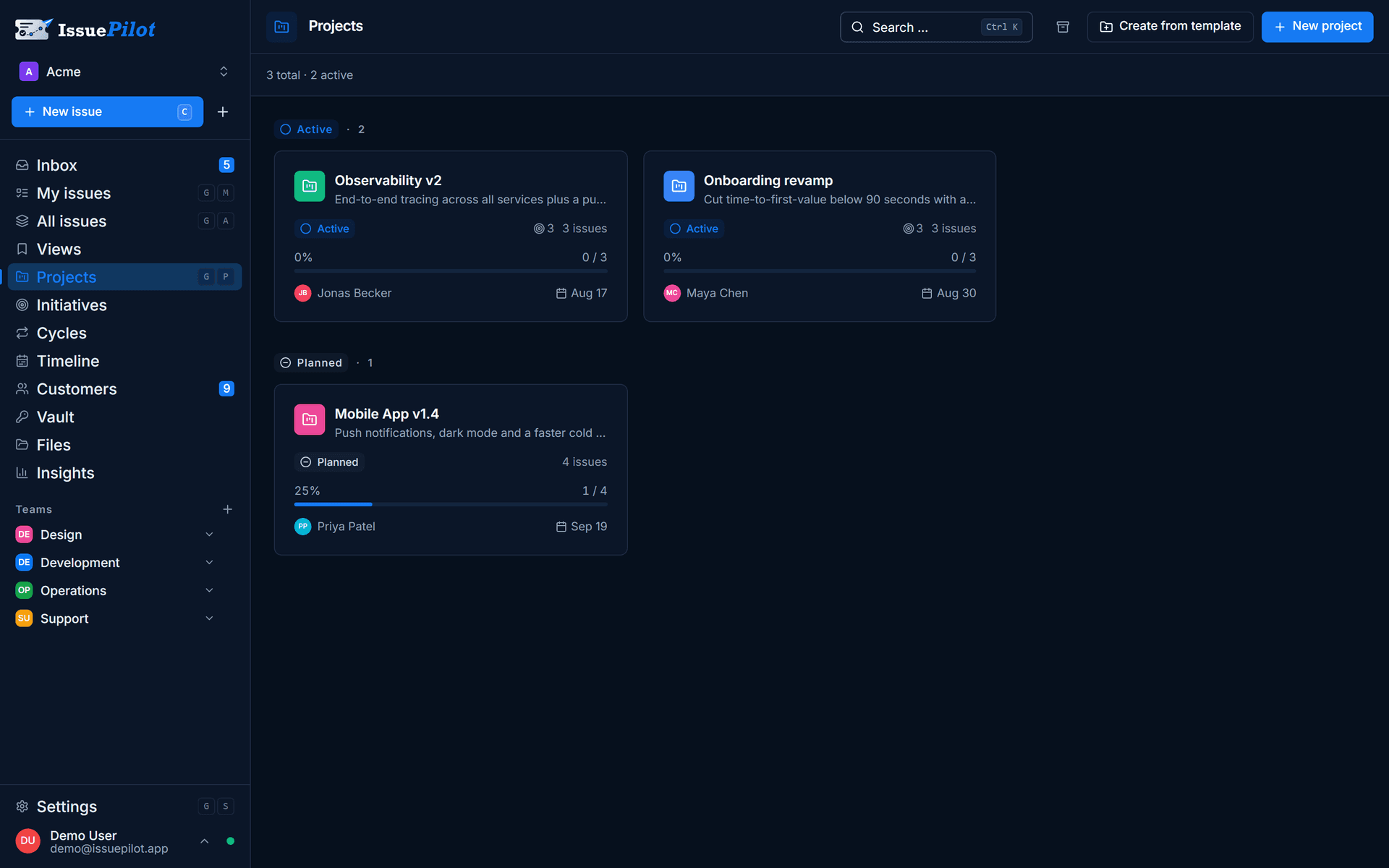
The project overview lists every client project with progress, owner and open tasks – without anyone writing a status report. Progress comes out of completed tasks, not out of an estimate.
For the question of whether a new client still fits, the timeline helps more than any capacity spreadsheet. Three milestones in the same week are visible immediately – early enough to move something before you commit.
What's stuck is the fourth view and the least comfortable one. Tasks waiting on a delivery or an approval look like work on a board but are standstill. Marked as blockers, they show up together instead of hiding in plain sight.
For agencies, the client channel matters on top of this: reports come in through the widget straight from the client's own website, with a screenshot and technical details attached. How that inbox gets sorted is covered in the article on turning phone requests into tasks, and the same routine applies whatever channel a report arrives through.
What this doesn't solve
Views make things visible; they don't decide. If five projects are simply too many for four people, the timeline will show that cleanly – it won't say no to the sixth client for you. That's precisely the value, though: saying no in July is a conversation, saying no in September is a loss of trust.
Nor does an overview replace ownership. Without one person sorting the inbox daily, even the best view fills up with unsorted items – and then nobody looks at it any more.
Common mistakes
- One board per client and nothing else: the cross-project view is missing exactly when you need it – at the capacity question.
- Hand-written status reports: anything someone has to maintain is stale by day three. Progress should come out of the work, not alongside it.
- Creating client reports directly as tasks: you lose the link back to the reporter – and with it the answer to „what came of it?“
- Treating waiting tasks like active ones: twelve tasks „in progress“, seven of which wait on approvals, aren't utilisation. They're a queue.
- Committing to dates without checking the timeline: two relaunches in the same week are rarely deliberate and usually avoidable.
In short
The Monday meeting is a good test. If it takes forty minutes because someone is collecting status, a view is missing. If it takes ten because everyone looks at the same overview and only decides, the setup is right.
Getting there is unspectacular: one place for all projects, a clean split between client request and internal task, and four angles on one data set instead of four maintained lists. What that means for agencies and web teams is on the agency page.
For agencies & web teams
Take a lookYannick Schneider
Founder of IssuePilot
Yannick builds websites and software for clients at Schneider & Liska Webservice. IssuePilot grew out of that everyday work – out of wanting to stop hunting for feedback, bugs and tasks across five different channels.
More about us